Research
Research
My research focuses on corporate finance, corporate governance, and financial intermediation, with a particular interest in emerging economies.
Work in Progress
Activist-Induced Turnover
Hannes F. Wagner, Yekta Yazdanifard · 2026
Draft in progress
Abstract
Activist investors are widely viewed as catalysts for board change, yet prior work estimates a limited scope of such changes. This paper introduces the concept of activist-induced turnover: board changes that would not have occurred absent an activist campaign. Using one of the most comprehensive samples of hedge fund activism available, we show that disclosed activist appointments do not capture the actual effect that activism has on boards. First, we use a large language model (LLM) to identify disclosed activist appointments, and show that the LLM-identified appointments closely match hand-collected data in Kang et al. (2022), within their 2006–2015 sample. Then, for our full sample of activist campaigns, we estimate activist-induced turnover and show that it is nearly three times as frequent as disclosed activist appointments alone, suggesting a significantly larger potential impact of hedge fund activism on board composition. Economy-wide, we estimate that activist-induced turnover represents 4.3% (rather than 1.45% if considering disclosed activist appointments only) of all public-firm board changes. Among targeted firms, induced turnover accounts for 29% of board turnover, compared with just 4.3% among all publicly traded firms. Importantly, we also show that activism sharpens the performance sensitivity of director turnover, with director turnover becoming significantly more responsive to poor performance following a campaign. Our paper suggests that activist campaigns are significantly more important for the composition of boards than previously assumed.
Bank Heterogeneity and Covariance-Based Amplification in the Sovereign-Bank Nexus
Süreyya Güder Köşgeroğlu · 2026
Data collection
Project Description
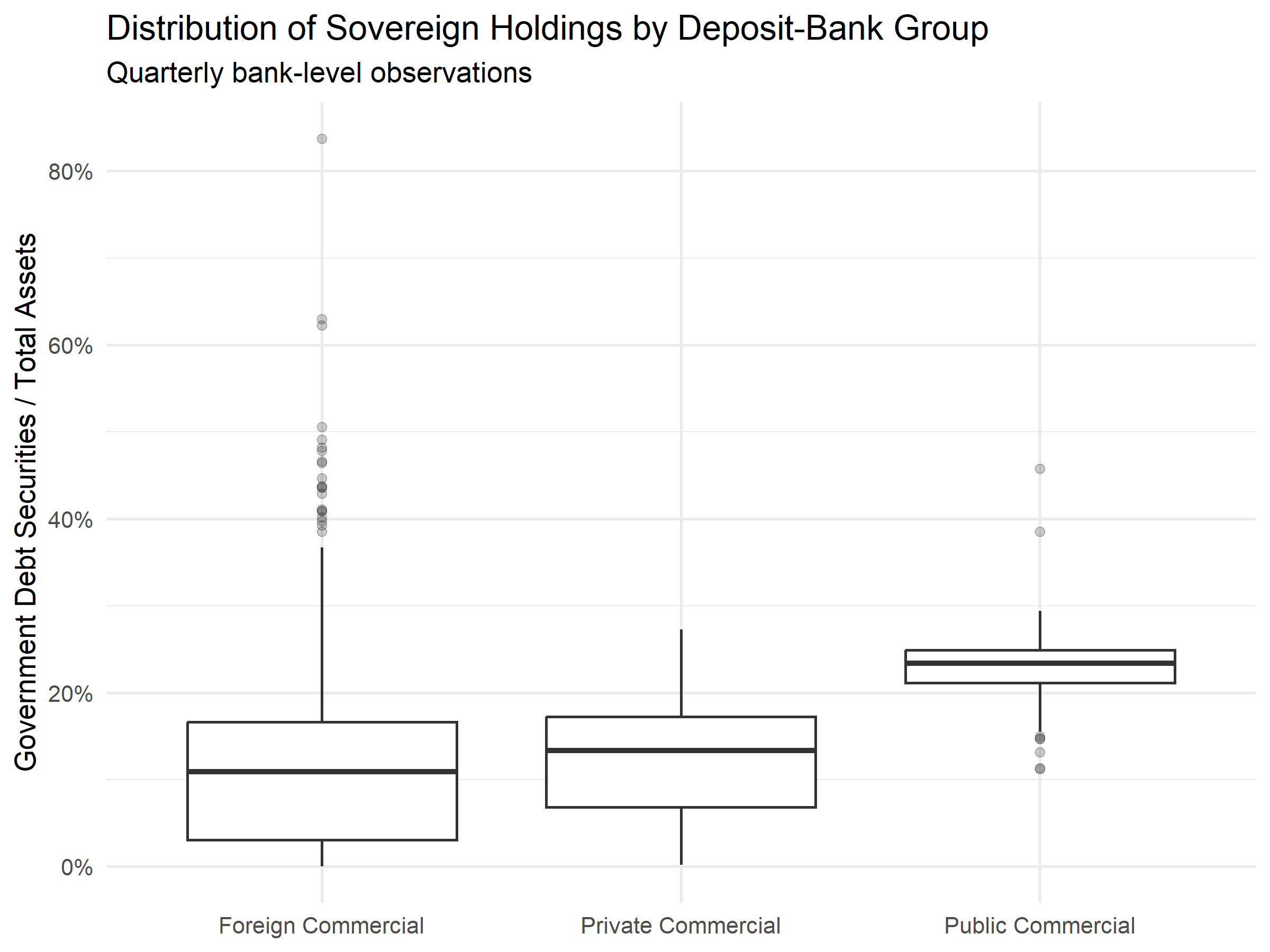
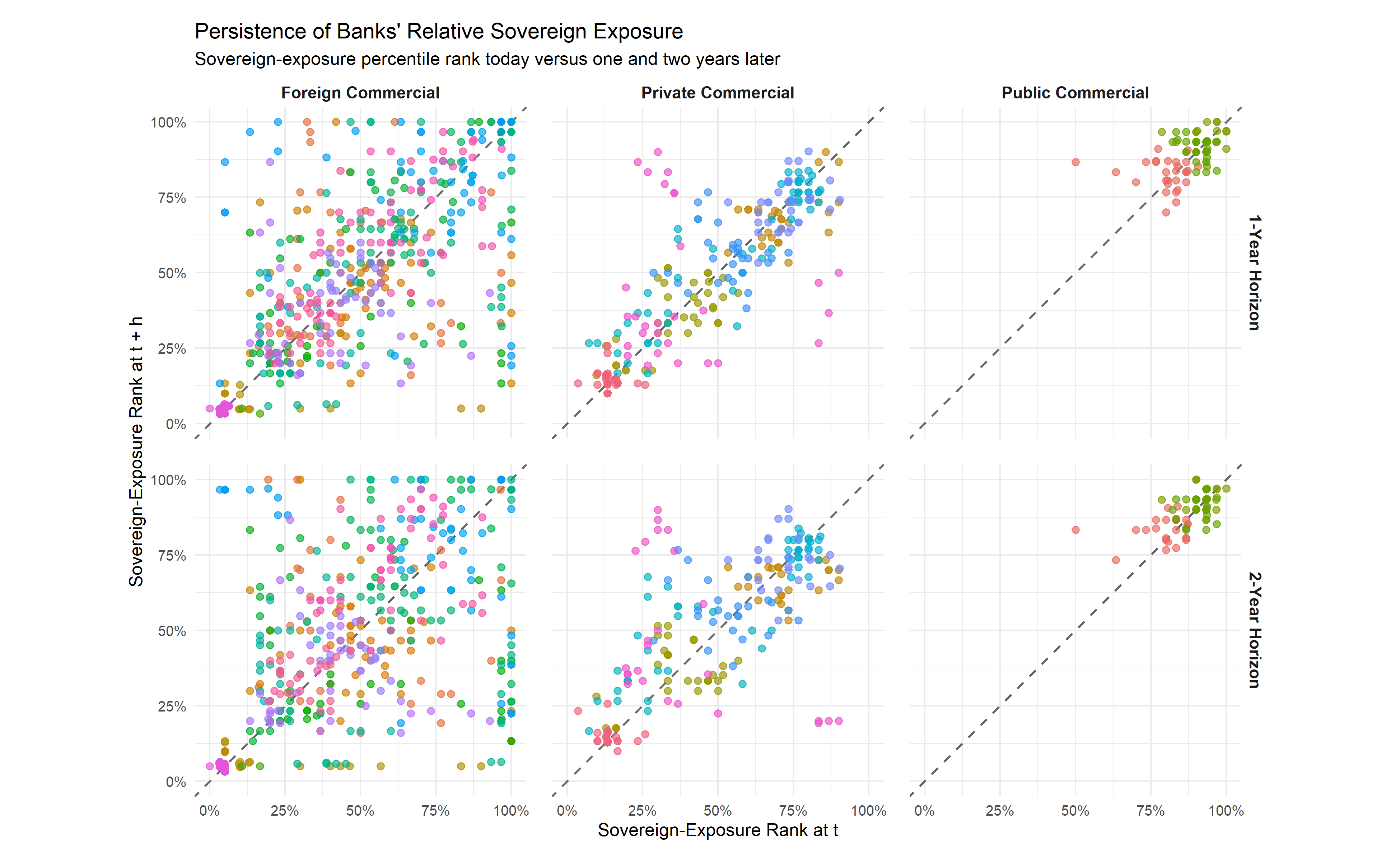
This project studies how banks’ sovereign asset holdings shape their responses to credit contractions after a shock. Turkey provides a particularly suitable setting for this question: as a bank-based economy with rich variation across bank types, it allows us to examine whether sovereign exposure differs systematically across institutions and whether these differences are persistent over time. Using bank-level Central Bank microdata, we document that deposit-bank groups hold sovereign assets at markedly different levels (Figure 1), and that banks’ relative positions in the sovereign-exposure distribution are highly persistent over one- and two-year horizons (Figure 2). This persistence is central to the amplification mechanism: when a credit shock hits, banks cannot quickly adjust their sovereign portfolios to insulate themselves, so pre-existing balance-sheet exposure may shape how strongly shocks are transmitted to credit supply.
Sovereign Default and Financial Architecture
Martin Gunter Kornejew, Emanuele Pizzochera · 2026
Project in progress
Project Description
Government defaults typically have devastating consequences for a financial system: they can absorb much of the risk-bearing capacity of domestic financial intermediaries, thus constraining funding to firms. Local financial architecture, however, can act as a buffer by moderating how government defaults transmit to the real economy. While government default can plunge banks into crisis, a well-developed corporate bond market could act as a "spare tire" for financial intermediation.